Differential Calculus
The study of rates of change and slopes of curves
Introduction to Differential Calculus
Differential calculus is a branch of calculus that studies rates of change and slopes of curves. It focuses on the concept of the derivative, which represents an instantaneous rate of change. The derivative of a function at a specific point measures the rate at which the function's value changes as its input changes.
The fundamental concept in differential calculus is the limit. The derivative is defined as a limit of the difference quotient:
This limit, if it exists, gives us the derivative of the function f at the point x. The derivative represents the slope of the tangent line to the graph of f at the point (x, f(x)).
Key Concepts
The Derivative
The derivative of a function f with respect to x is denoted by f'(x) or . It represents the instantaneous rate of change of f with respect to x.
Basic Differentiation Rules
Constant Rule:
The derivative of a constant is zero.
Power Rule:
For any real number n, the derivative of x^n is n times x^(n-1).
Sum Rule:
The derivative of a sum is the sum of the derivatives.
Product Rule:
The derivative of a product is the first function times the derivative of the second, plus the second function times the derivative of the first.
Quotient Rule:
The derivative of a quotient follows this formula where the denominator is squared.
Chain Rule:
The derivative of a composite function is the derivative of the outer function evaluated at the inner function, multiplied by the derivative of the inner function.
Common Derivatives
Trigonometric Functions:
Exponential and Logarithmic:
Examples
Example 1: Power Rule
Example 2: Product Rule
Example 3: Chain Rule
Applications
Differential calculus has numerous applications in engineering and science:
- Rate of Change Analysis: Determining how quickly quantities change with respect to time or other variables.
- Optimization Problems: Finding maximum or minimum values of functions to optimize designs or processes.
- Motion Analysis: Calculating velocity and acceleration from position functions.
- Curve Sketching: Analyzing the behavior of functions to sketch their graphs.
- Approximation Methods: Using linear approximation and differentials to estimate function values.
In engineering, differential calculus is essential for analyzing rates of change in physical systems, optimizing designs, and modeling dynamic behavior.
Learning Resources
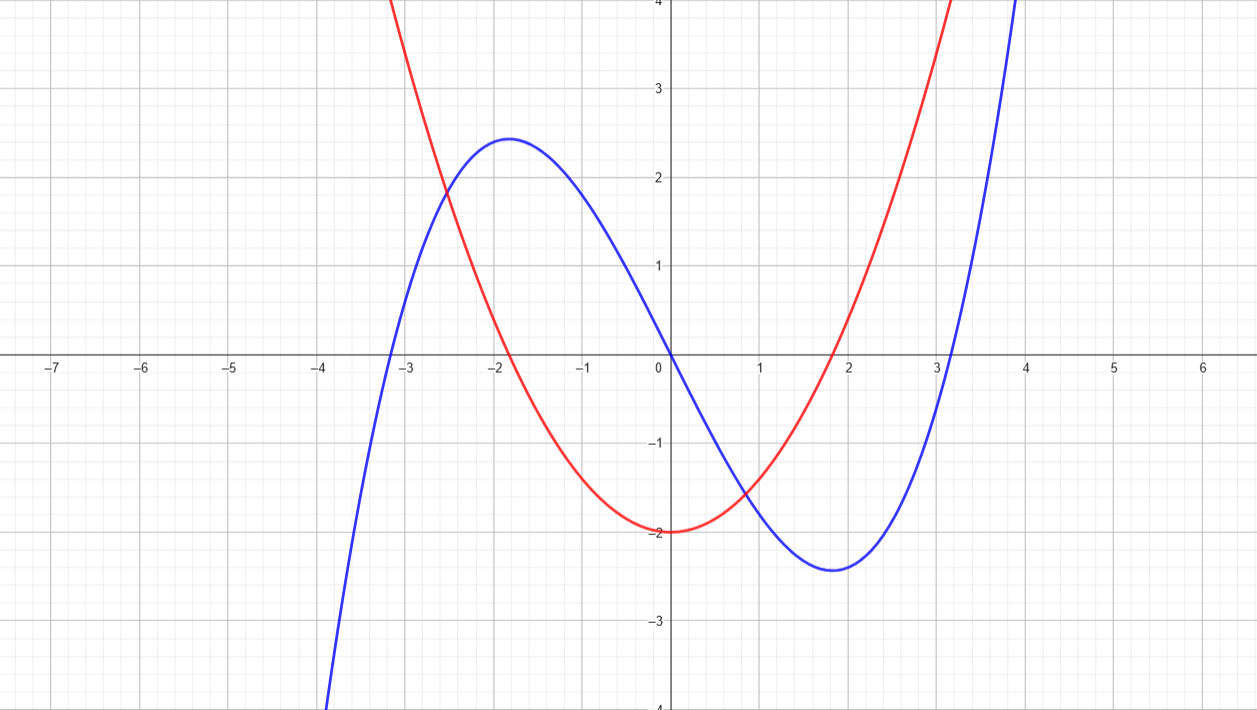
Visualization of a function (blue) and its derivative (red)