Integration by Definition
Approximating area under the curve and Riemann sums
Introduction to Integration by Definition
Integration by definition is a fundamental approach to calculating the area under a curve. Before the invention of calculus, mathematicians approximated these areas by dividing the region into simpler shapes, such as rectangles, and summing their areas. This method evolved into what we now know as the definite integral.
The definite integral of a function f(x) from a to b is defined as the limit of a Riemann sum as the number of subdivisions approaches infinity:
Where Δx = (b-a)/n is the width of each subinterval, and x_i* is a point in the i-th subinterval.
Left and Right Sums
Left Sum
In the left sum, we take the function value at the left endpoint of each subinterval:
Where is the left endpoint of the i-th subinterval.
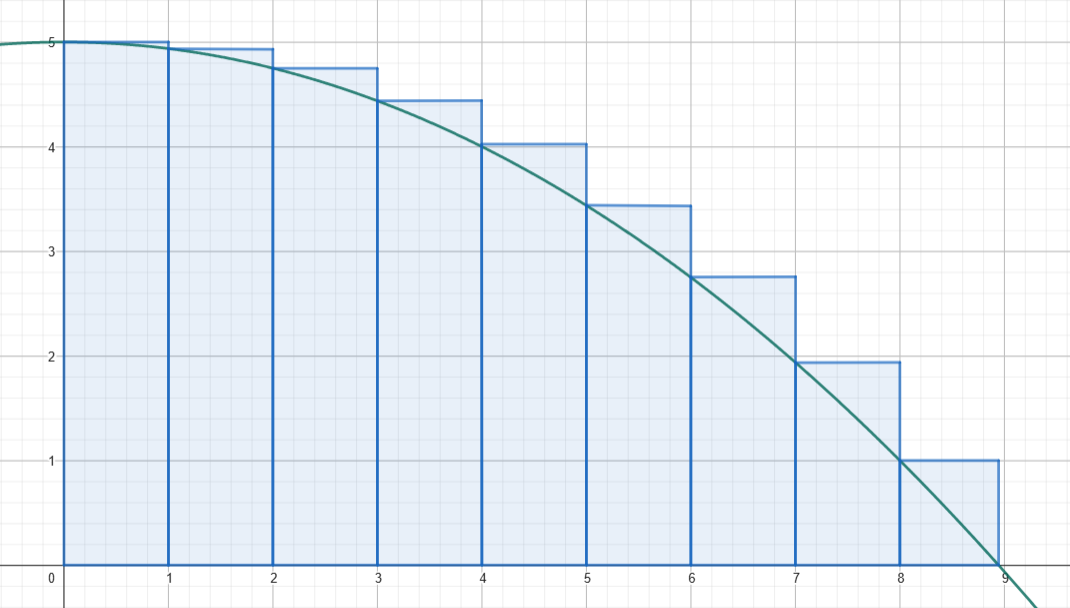
Approximation of the area under the curve using left sum
Right Sum
In the right sum, we take the function value at the right endpoint of each subinterval:
Where is the right endpoint of the i-th subinterval.
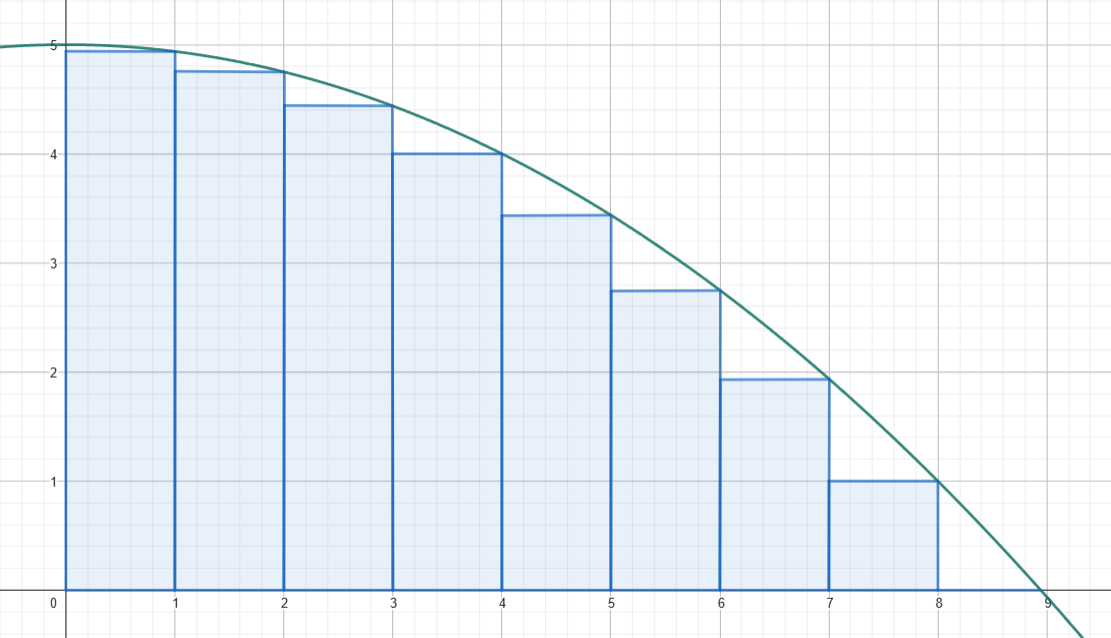
Approximation of the area under the curve using right sum
Comparison of Sums
For an increasing function on [a, b], the left sum underestimates the area, while the right sum overestimates it. For a decreasing function, the opposite occurs.
As n increases, both the left sum and the right sum approach the actual value of the definite integral:
Riemann Sums
General Riemann Sum
A Riemann sum generalizes the left and right sums by allowing the evaluation point to be any point within the i-th subinterval:
Where is a point in the interval .
Midpoint Sum
The midpoint sum is a special case of the Riemann sum where is the midpoint of each subinterval:
The midpoint sum typically provides a better approximation than the left or right sums with the same number of subintervals.
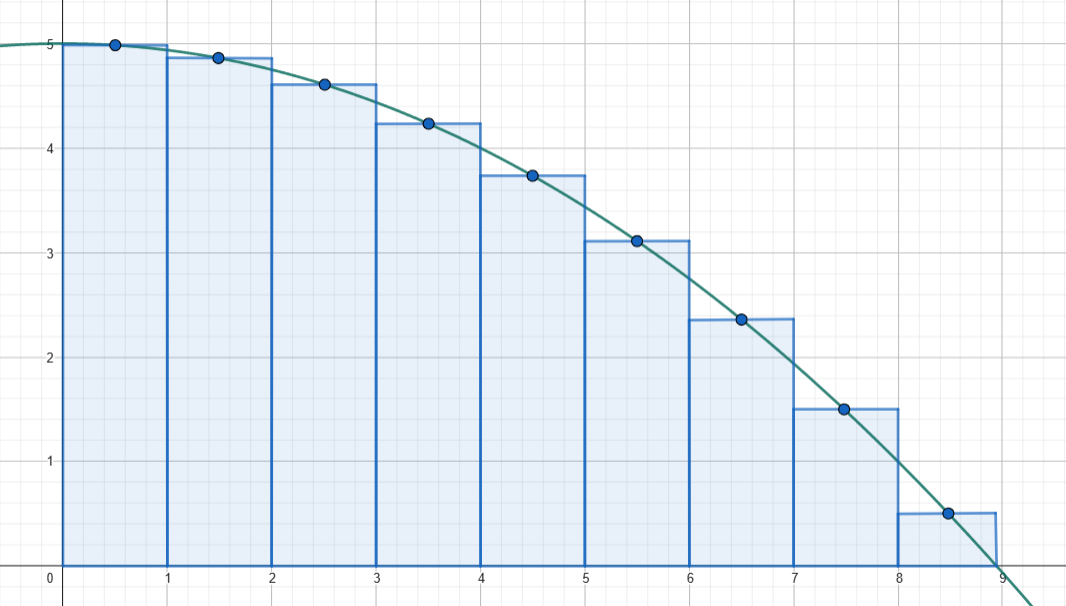
Approximation of the area under the curve using midpoint sum
Trapezoidal Sum
The trapezoidal sum approximates the area under the curve using trapezoids instead of rectangles:
The trapezoidal sum can be viewed as the average of the left and right sums:
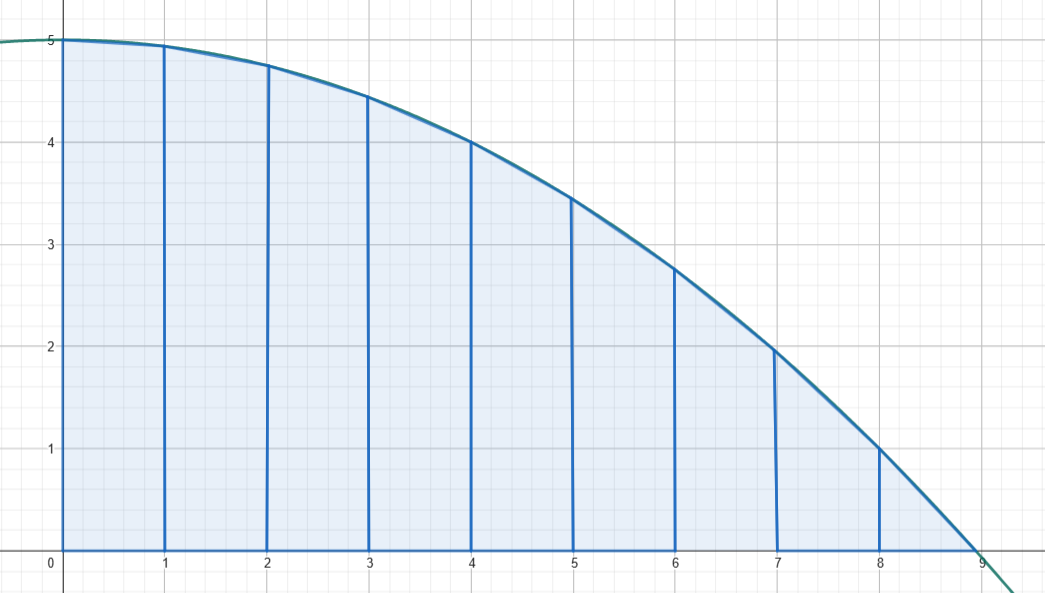
Approximation of the area under the curve using trapezoidal sum
Examples
Example 1: Approximation with Left and Right Sums
Example 2: Approximation with Midpoint Sum
Example 3: Approximation with Trapezoidal Sum
Applications
Integration by definition has numerous applications in engineering and science:
- Numerical Methods: When integrals cannot be solved analytically, numerical methods based on Riemann sums provide accurate approximations.
- Physics: Calculation of work, energy, centers of mass, and moments of inertia.
- Engineering: Signal analysis, flow calculations, and structural design.
- Economics: Calculation of consumer and producer surplus.
- Probability and Statistics: Calculation of probabilities and expected values.
Understanding integration by definition provides a solid foundation for integral calculus and its applications in various fields.